Admissions Open

Applications for the 2027–28 academic year close on 31 July. Campus tours every Saturday.

Our people

The teacher in the playground.

In the Salesian tradition, a teacher is found among children rather than above them — in the corridor, at the bench, on the field. We hire for that instinct first, and everything else follows from it.

Don Bosco, who began this family of schools in nineteenth-century Turin, left his teachers a deceptively simple test: are the children known? Not managed, not ranked, not merely taught — known. It is the measure we still hold ourselves to. A teacher here can post excellent results and still be having a difficult year, if the quiet child at the back has slipped past unnoticed.

His method has a name — the Preventive System — and three plain ingredients: reason, religion and loving-kindness. Reason, because children deserve to be told the why of a rule and not merely handed it. Religion, understood broadly, because a school should point at something larger than a mark sheet. And loving-kindness, the hardest of the three to fake, because a child can tell within a week whether an adult is genuinely on their side.

We do not ask whether a class did well. We ask whether every child in it was known by name.

That conviction shapes ordinary Tuesdays. Class teachers meet weekly and talk about individuals — this one has gone quiet, that one has stopped putting a hand up, another has suddenly bloomed — long before any of it would surface in an exam. The habit we prize most is unglamorous and unpaid: the teacher who stays back twenty minutes for the child who is a step behind, and who does not mention it again. We would rather appoint a patient teacher than a brilliant one, and we are fortunate to meet many who are both.
Leadership

The people who set the tone.

A school takes its temperament from the adults who lead it. Ours is led by a Salesian Sister whose standard for the place is exactly the one she sets for herself.

Please note: apart from the Principal, the names, photographs and qualifications shown in this section are placeholders. They will be completed and verified by the school before this website goes live.

Principal
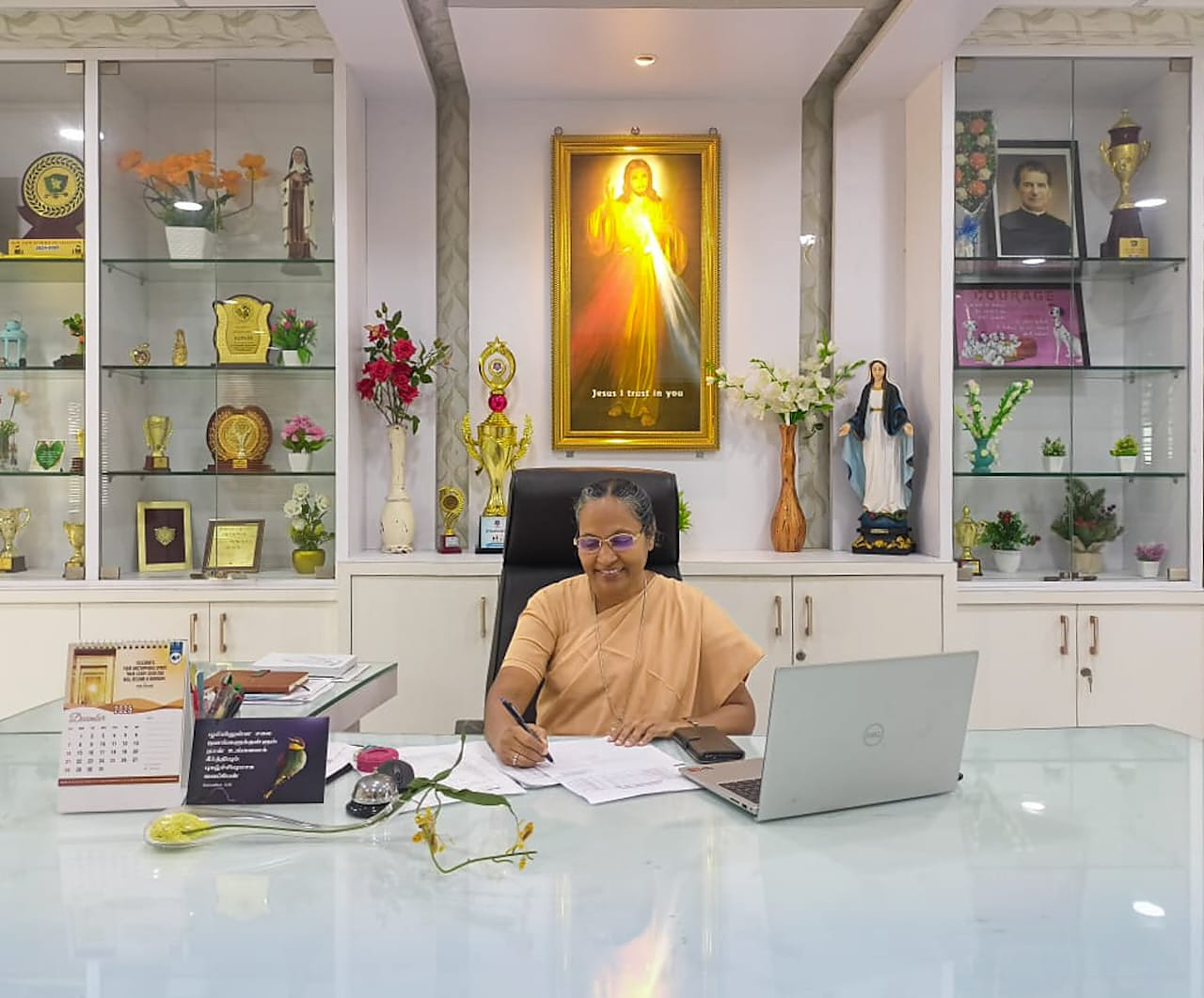
Sr. Dr. Peter Selvarani, Principal, at her desk in the school office
Principal's portrait Head-and-shoulders portrait, natural light, plain background. Portrait, 4:5.

Sr. Dr. Peter Selvarani

A Salesian Sister of Don Bosco and the school's Principal, Sr. Selvarani holds a doctorate and has led the community since its early years. She is known for keeping her office door open and her opening addresses short, and for judging the school by the child who needed it most.

Vice Principal
The school building seen from across the playground
Portrait Head-and-shoulders portrait, natural light, plain background. Portrait, 4:5.

Vice Principal

Oversees the day-to-day academic life of the school — timetabling, teaching standards and the pastoral care that runs alongside them — and stands in for the Principal when needed.

[Name to be added]
Headmistress
The school building seen from across the playground
Portrait Head-and-shoulders portrait, natural light, plain background. Portrait, 4:5.

Headmistress, Primary

Leads the Kindergarten and Primary years, where the school's warmth is first felt. Guards the reading, the play and the settling-in that everything later depends upon.

[Name to be added]

Departments

Six departments, one shared habit.

Each subject is taught by teachers who love it themselves — and who teach it as a way of thinking, not a list to be memorised.

Languages

Reading widely and writing clearly, secured early. Grammar is taught in service of expression, never as an end in itself.

English Tamil Hindi

Mathematics

Number sense before technique. Children are taught to explain why an answer is right, so that arithmetic becomes reasoning rather than ritual.

Arithmetic Geometry Algebra

Sciences

Science is done at a bench, not watched on a projector. Students ask a question, design a test, and change their minds when the evidence asks them to.

Physics Chemistry Biology

Social Sciences

History, geography and civics taught as the story of how people have chosen to live together — and the questions still left open for this generation.

History Geography Civics

Computer Science

From logical thinking to real code, on one machine per student. We teach computing as a craft — and as a set of habits for using technology wisely.

Computing Coding Digital literacy

Arts & Physical Education

Music, art and sport are not extras but part of the timetable. A confident body and a made thing teach a child things a worksheet cannot.

Art Music Sport

How we hire

How we choose a teacher.

A degree gets a candidate through the door. What we are really looking for takes longer to see, so our process is deliberately slow.

A real lesson, with real children

Every candidate teaches an actual class, not a mock one performed for the panel. We watch how a room responds to them — whether the quiet children lean in, whether a wrong answer is met with patience — because that is the job, and it cannot be rehearsed.

The demonstration lesson

A conversation about one struggling child

We describe a real kind of child — behind in reading, anxious, easily lost — and ask the candidate to think aloud about how they would help. The answer tells us more about a teacher than any certificate: whether their first instinct is the mark or the person.

The interview

References and background verification

We speak to previous schools, check qualifications, and complete the background and identity checks that every adult on a campus of children must clear. It is unglamorous, and it is non-negotiable.

Due diligence

A term of mentoring before a class of their own

New teachers spend their first term alongside an experienced colleague — observing, being observed, and talking it over afterwards — before they take sole charge of a class. No one is left to sink, and no class is anyone's first experiment.

Mentored induction

Growing our teachers

A teacher who has stopped learning cannot teach it.

Good teaching is a practice, not a possession — so we keep our teachers learning. Every member of staff takes part in regular CBSE training to stay current with the curriculum and how it is best examined.

Inside the school, teachers observe one another and give honest, kind feedback; a lesson is something colleagues discuss, not something judged once a year. And every adult on campus — teaching or not — completes child-protection training, because a safe school is the floor beneath everything else we promise.

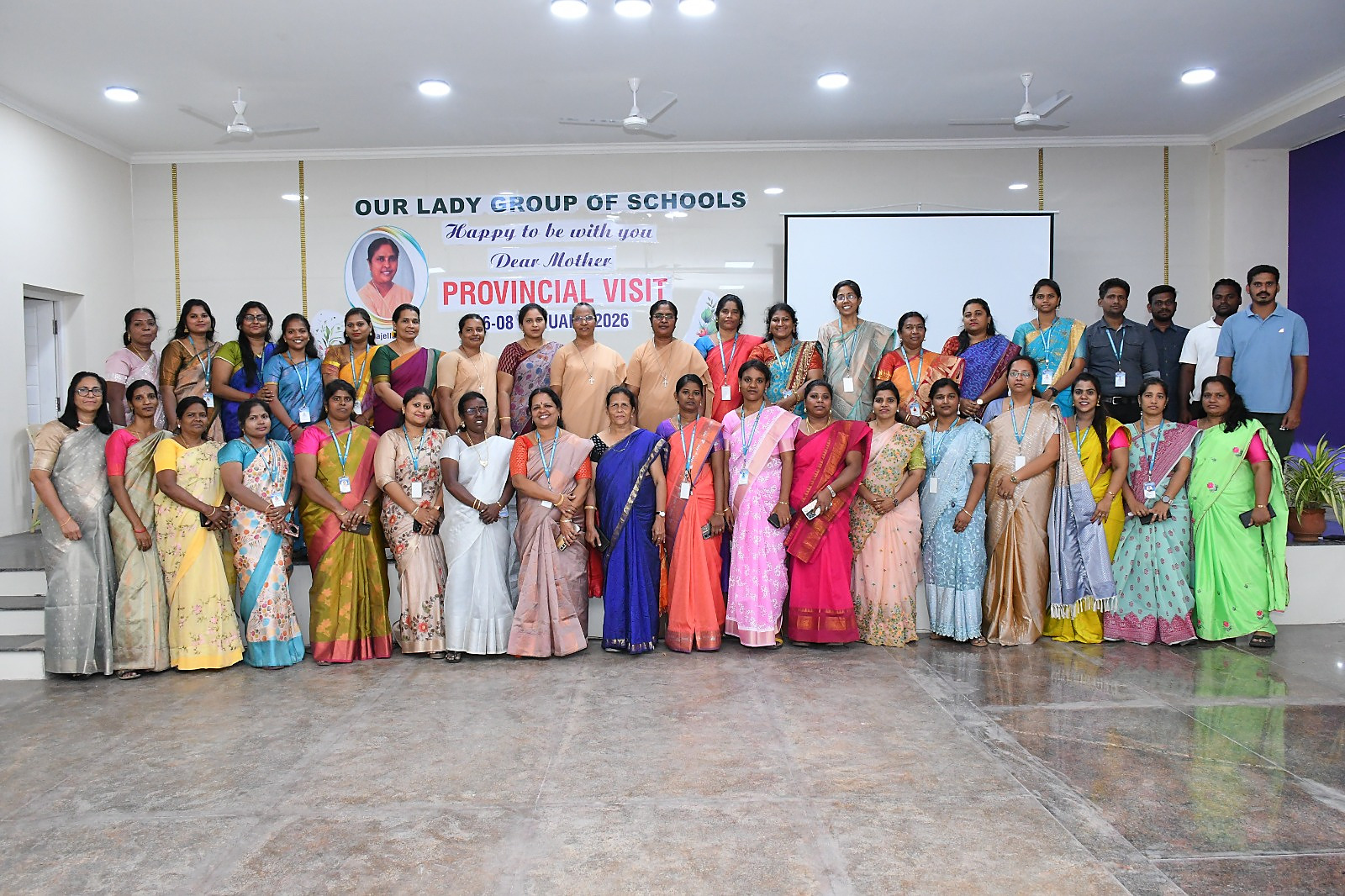
The staff of Our Lady School of Excellence assembled in the school hall
Staff workshop Teachers around a table in a training session, mid-discussion. Portrait, 4:5.

In their words

How it feels from the inside.

I was asked at my interview how I would help one particular child who was behind. Six years on, that is still the question the school asks me about my class every single week.

T
A teacherMiddle School

My class teacher noticed I had gone quiet before I even knew I had. She just started sitting with me at lunch. Nobody made a thing of it, and slowly I was fine.

S
A studentClass VIII

Illustrative testimonials — replace with signed, attributable quotes before launch.

1:22Teacher–student ratio
100%Teachers CBSE-trained
100%Staff background-verified
100%Adults child-protection trained

Illustrative figures — replace with verified staffing data before launch.

Join the staff room

Teach here.

If you are the kind of teacher who is happiest in the playground — who wants to be measured on whether children are known, not only on results — we would like to hear from you. Send a short note about yourself and your teaching to our office, and tell us about a child you helped.

ourladytvt2018@gmail.com

About the school

The people are the school.

Founded in 2018 by the Salesian Sisters of Don Bosco, teaching Kindergarten to Class X through reason, faith and loving-kindness. Come and meet the teachers on an ordinary Tuesday.